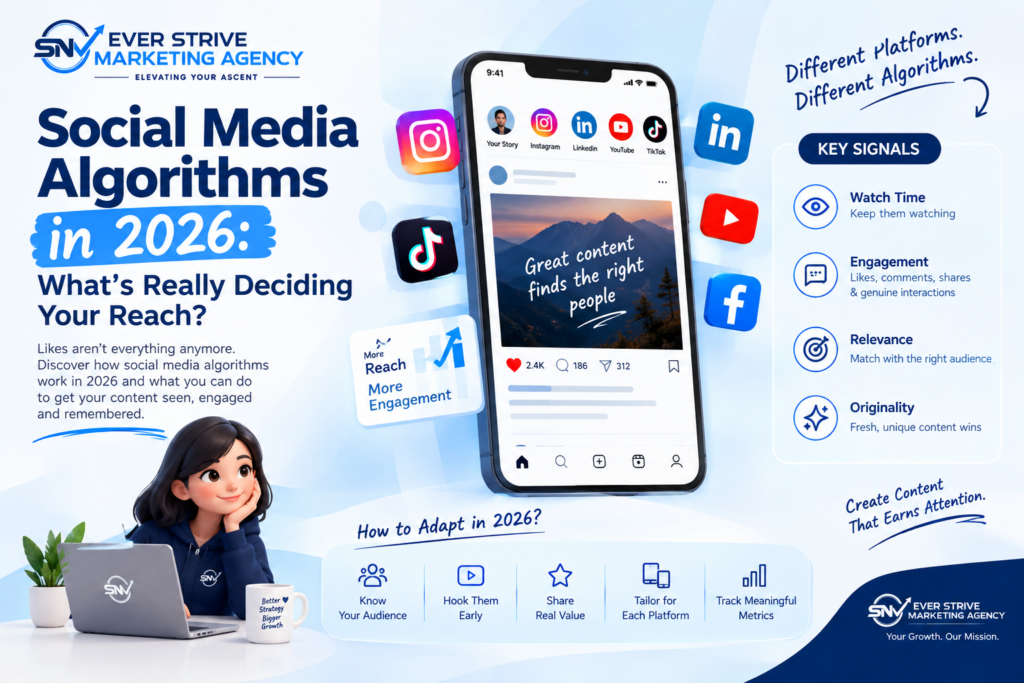
Social Media Algorithms in 2026: What’s Really Deciding Your Reach?
Social media has changed significantly. Having thousands of followers no longer guarantees that every post will reach those followers.
Platforms such as Instagram, Facebook, LinkedIn, YouTube and TikTok use recommendation and ranking systems to decide which content appears, to whom, and in what order. In 2026, these systems are becoming increasingly AI-driven and focused on understanding content, user interests and behaviour.
For businesses, this means social media success is becoming less about simply posting frequently and more about creating content that people genuinely find relevant and worth their attention.
What Are Social Media Algorithms?
A social media algorithm is a collection of ranking and recommendation systems that helps a platform determine which content to show each user.
Instead of displaying every new post chronologically, platforms use signals such as previous interactions, content relevance, viewing behaviour and engagement to predict what a particular user may want to see.
This means two people can open the same platform at the same time and receive very different feeds.
AI Is Changing How Content Gets Ranked
One of the biggest changes in social media is the increasing use of AI to understand content and user interests.
LinkedIn announced in 2026 that it is upgrading Feed ranking with Generative Recommenders and large language models (LLMs). These systems are designed to better understand what a post is about and how a member’s professional interests change over time.
This is important for marketers because algorithms are becoming better at understanding context, not simply counting likes.
A post that clearly communicates a useful idea to a specific audience can therefore have value beyond its immediate engagement numbers.
What Signals Matter in 2026?
Every platform has its own ranking system, but several signals commonly influence distribution.
1. Watch Time
For video content, getting someone to stop scrolling is only the beginning. Keeping their attention can be an important signal.
This makes the first few seconds of a Reel, Short or video particularly important.
2. Engagement
Likes, comments, shares and other interactions provide information about how people respond to content.
However, engagement quality matters too. LinkedIn says it is working to reduce automated comments, engagement pods and other forms of inauthentic engagement.
3. Relevance
Platforms try to match content with people who are likely to be interested in it.
That means marketers should create content for a specific audience, rather than trying to appeal to everyone.
4. Originality
Original content is becoming increasingly important. Meta reported that, in Q4 2025, 75% of Instagram recommendations in the US came from original posts, while Facebook was also increasing the amount of same-day Reels being recommended.
For brands, simply reposting the same content repeatedly may not be enough to build sustainable organic reach.
Every Platform Has a Different Algorithm
There is no single “social media algorithm.”
Instagram: Video viewing behaviour, likes, shares and relevance can influence distribution.
LinkedIn: Professional relevance, content quality and meaningful engagement are important areas of its Feed ranking system. LinkedIn is also reducing generic and engagement-bait content.
YouTube: Viewer behaviour, relevance and satisfaction influence recommendations.
Facebook: Recommendations and Feed ranking use signals around predicted engagement, relationships and content relevance.
This is why copying exactly the same post across every platform may not produce the same results.
What Should Businesses Do Differently?
Instead of asking “How often should we post?”, businesses should also ask:
Is this content relevant to our target audience?
Does the opening make people want to continue watching?
Does the content provide a useful idea or perspective?
Would someone naturally share or save it?
Are we creating original content?
Are we adapting the format for each platform?
Are we measuring meaningful results rather than only likes?
The goal shouldn’t be to “hack” an algorithm. It should be to create content that earns attention from the right audience.
The Biggest Social Media Mistake in 2026
One common mistake is treating every platform as if it works the same way.
A LinkedIn post designed for professional insights may need a completely different approach from an Instagram Reel designed for visual discovery.
Similarly, posting more content does not automatically mean more reach. Current industry analysis highlights watch time, engagement and relevance as recurring signals across major platforms, while the exact weighting differs by network.
Conclusion
Social media algorithms are becoming more sophisticated and increasingly AI-powered. The focus is shifting from simply distributing content to predicting what each person is most likely to find useful or interesting.
For businesses, the takeaway is simple: don’t create content only because the calendar says it’s time to post.
Create content with a clear audience, strong relevance, genuine value and a reason to keep watching or engaging.
SNV Ever Strive Marketing Agency Your Growth. Our Mission.