-
admin
- No Comments
- September 25, 2026
Meta Muse AI: How Meta’s Personal AI Agent Is Changing Digital Marketing
Artificial intelligence is moving beyond answering questions.
On September 8, 2026, Meta introduced Muse, a personal AI agent designed to do more than generate responses. Muse can understand goals, create plans, interact with websites and connected services, and complete tasks on a user’s behalf. Meta describes it as a personal AI agent built to help people turn their goals into action.
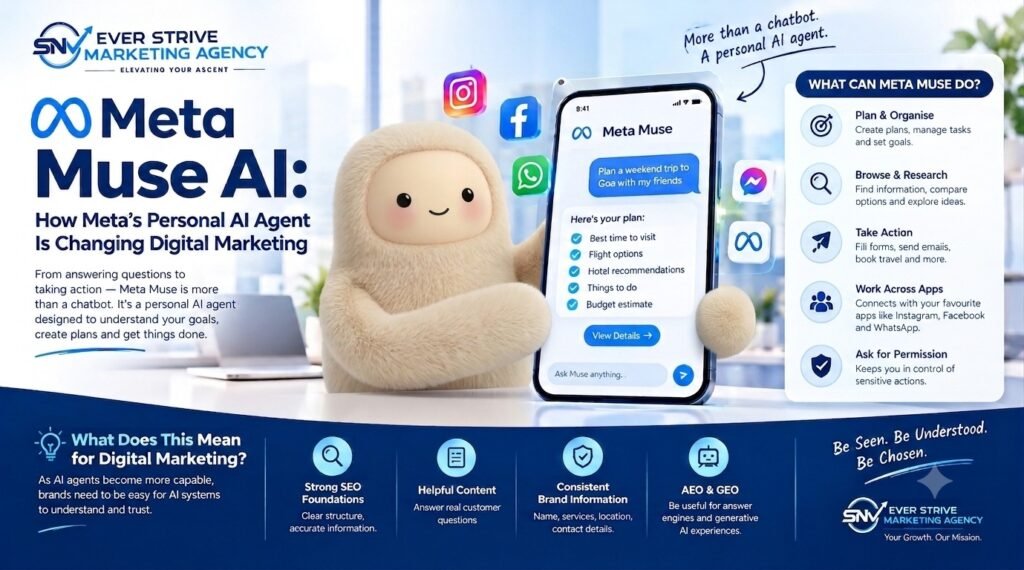
For businesses, creators and digital marketers, this development points toward a significant change in how people may discover information, interact with brands and complete everyday tasks online.
What Is Meta Muse?
Meta Muse is Meta’s personal AI agent designed to proactively help users with tasks and longer-term goals.
Unlike a traditional chatbot, which generally waits for a prompt and responds, Muse is designed to take action. Users can tell Muse what they want to accomplish, and it can create a plan, work through tasks and return when it needs approval.
Meta says Muse can browse the web, fill out forms, send emails, book travel and handle other tasks. It can also continue working after the user closes the app and ask for approval before sensitive actions such as sending an email or making a purchase.
This represents a shift from AI that answers to AI that acts.
How Does Meta Muse Work?
Muse runs through what Meta calls Muse Secure VM, a dedicated virtual machine designed to separate the AI agent, user data and connected services.
The system includes controls intended to give users more control over what Muse can access. Users choose which services to connect and what permissions to provide. Meta also says Muse maintains an audit trail and asks for permission before certain sensitive actions.
For users, the experience is intended to be simple:
Tell Muse the goal → Muse creates a plan → Muse works on the task → User reviews or approves when required
That makes the technology different from simply asking an AI assistant to write something or answer a question.
Muse and Social Media
Muse is particularly interesting from a social media perspective because Meta operates platforms such as Instagram, Facebook and WhatsApp.
Meta says Muse can remember relevant information from conversations and connected experiences. For example, Meta describes a scenario where a recipe saved on Instagram could eventually be turned into a grocery list and used to help plan a dinner.
This illustrates how AI could connect content discovery with real-world action.
Today, a consumer might:
See a Reel → Search for the product → Visit a website → Compare options → Purchase
With increasingly capable AI agents, some of these steps could potentially be handled through an agent working on the user’s behalf.
That could have major implications for brands and marketers.
What Does Meta Muse Mean for Digital Marketing?
The growth of AI agents could change the way customers discover and evaluate businesses.
Digital marketing has traditionally focused on visibility across search engines, social platforms, websites and advertisements.
But if consumers increasingly use AI agents to research products, compare businesses or complete tasks, brands will also need to make their information easy for AI systems to understand.
This makes several areas increasingly important:
1. Strong SEO Foundations
Websites still need clear structure, useful content and accurate information so search engines and AI systems can understand them.
2. Helpful Content
Businesses should answer real customer questions rather than creating content only to target keywords.
3. Consistent Brand Information
Business names, services, contact information, locations and other important details should remain consistent across digital platforms.
4. AEO and GEO
Answer Engine Optimization (AEO) focuses on making content useful for systems that provide direct answers.
Generative Engine Optimization (GEO) focuses on helping brands become more understandable and discoverable within generative AI experiences.
As AI agents become more capable, these areas may become increasingly relevant alongside traditional SEO.
Muse Is Moving Beyond the Phone
Meta’s latest announcement makes Muse even more interesting.
On September 24, 2026, Meta announced that Muse is coming to its AI glasses in the coming months. Meta demonstrated how users could ask Muse about something they are looking at, such as a product on a shelf, a flyer or a list of items, without having to describe the object manually.
Meta also announced a voice mode and additional connectors, including services for shopping, travel and productivity.
This could eventually make AI interaction much more natural:
See → Ask → Understand → Act
Instead of opening a search engine and manually researching something, users may increasingly rely on an AI agent to interpret information and help complete the next step.
Why Should Businesses Pay Attention?
Muse is still an emerging technology, but its development highlights a broader direction in AI.
The progression is moving from:
AI answers → AI assistance → AI automation → AI agents
Businesses don’t necessarily need to automate everything.
Instead, they should build a strong digital foundation that both people and AI systems can understand.
That means maintaining an accurate website, creating useful content, strengthening brand authority, keeping business information consistent and adapting to new search and discovery behaviors.
For digital marketers, this means the focus is no longer only on “How do we rank?”
The bigger question is increasingly:
“Can our brand be clearly understood when an AI is helping someone make a decision?”
The Future of AI and Digital Marketing
Meta Muse is an early example of how AI agents could change the relationship between people, information and online services.
The technology is moving beyond generating text and images toward understanding goals and taking actions.
For businesses, the opportunity is to prepare now by creating a digital presence that is clear, trustworthy, useful and easy to understand.
SEO will remain important. Social media will remain important. Paid advertising will remain important.
But as AI agents become more capable, the way people discover and interact with brands may change significantly.
The future of digital marketing may not simply be about being visible online. It may be about being understandable to both people and the AI systems helping them make decisions.
At SNV Ever Strive Marketing Agency, we believe staying updated with developments such as Meta Muse is essential for businesses that want to adapt to the next phase of digital marketing.Meta Newsroom