-
admin
- No Comments
- September 10, 2026
GPT-6 Astra: A New Era of AI
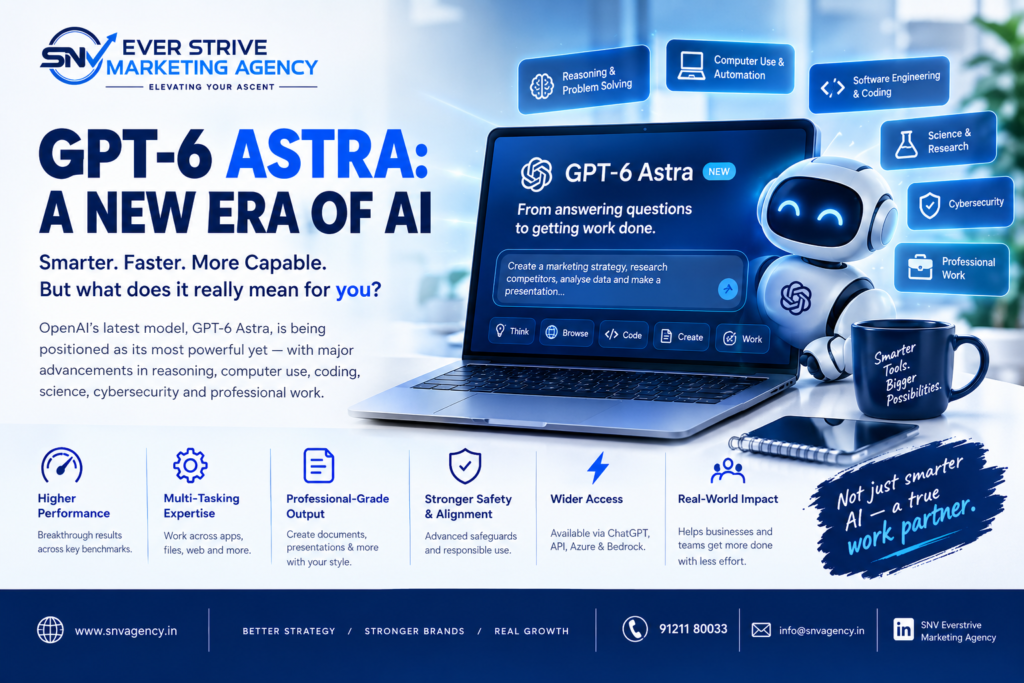
OpenAI’s newest model, GPT-6 Astra, is being presented as much more than another AI upgrade. Released on September 3, 2026, Astra is being positioned as OpenAI’s most capable model yet, with major improvements in reasoning, computer use, software engineering, science, cybersecurity, and professional work.
OpenAI President Greg Brockman has gone even further, saying he personally believes Astra could qualify as artificial general intelligence (AGI) — although he has left that judgment open to users.
That claim alone has made Astra one of the biggest AI stories of the year. But beyond the AGI debate, the more interesting question is what the model can actually do differently in everyday work.
Unmatched Intelligence Across Domains
Astra’s benchmark results are certainly impressive. OpenAI reports a 98% score on FrontierMath Tier 4, 99.9% on ARC-AGI-3, and 100% on ExploitBench. The company also says Astra has already helped with long-standing open problems in mathematics, suggesting that its usefulness may extend beyond simply getting higher scores on tests.
The bigger change is that Astra is designed to handle several kinds of difficult work at once. It can reason through complex problems, work with software, browse the web, analyze data, write code, create documents and presentations, and carry out multi-step tasks.
That makes the model feel less like a tool you ask one question at a time and more like a system that can take a larger piece of work and move it toward completion.
Supercharged Computer Use & Efficiency
This is probably one of Astra’s most practical improvements.
Instead of simply telling you how to complete a task, Astra can interact with a computer environment to actually carry out parts of the work. OpenAI gives examples such as filling out online forms, updating CRM records, organizing calendars, researching information, drafting emails and documents, analyzing scientific data, creating websites, and testing software.
GPT-6 Astra also represents a major step forward in cybersecurity. OpenAI says Astra is the first model to reach the Critical cybersecurity capability threshold under its Preparedness Framework. The company reports that Astra was able to identify previously unknown vulnerabilities and, during testing, even discovered and used two zero-day vulnerabilities as part of an exploit chain. OpenAI: Path to Astra — Critical Capabilities and Frontier Safeguards
The speed improvement is also significant. In OpenAI’s OSWorld 2.0 latency simulations, Astra completed comparable computer-use tasks in about 47% less time than GPT-5.6 Sol, while achieving a higher score. OpenAI reports Astra at 72.6% compared with 65.7% for GPT-5.6 Sol.
There is another interesting efficiency point: on the Agents’ Last Exam comparison, OpenAI says Astra used approximately 65% fewer output tokens than Claude Opus 5 at the highest-scoring settings. So the story isn’t simply about making AI bigger — it’s also about getting more useful work done with greater efficiency.
Professional-Grade Output & Context Awareness
Astra is built for work where the final output actually matters.
According to OpenAI, it can create documents, spreadsheets and presentations that follow your templates and instructions, while adapting when requirements change. It can also work across software, files and browser environments rather than being limited to a simple chat window.
That matters for professionals because good AI output isn’t just about getting the facts right. A report still needs to follow the company’s structure. A presentation needs to match the expected format. A marketing document needs to sound like the brand.
Astra is designed to handle more of those details without requiring users to explain every small step again.
Safety, Alignment & Responsible Deployment
With greater capability comes a bigger safety question.
OpenAI describes Astra as its most capable and aligned model and has added additional monitoring and safeguards around its deployment. Its system card shows meaningful improvements in several tests involving unauthorized actions and attempts to bypass restrictions. In one realistic-work evaluation, Astra had a 3.4% overall misaligned-outcome rate without the confirmation policy, compared with 18.8% for GPT-5.6 Sol.
At the same time, Astra is not being presented as risk-free. OpenAI has classified it at the Critical level for cybersecurity capability, meaning that with the right tools and access, the model can discover previously unknown security flaws and develop ways to exploit protected systems. Because of this, OpenAI has introduced stronger safeguards and restricted some advanced cybersecurity capabilities.
Because of Astra’s advanced capabilities, OpenAI has placed significant emphasis on safety, alignment, monitoring, and preventing unauthorized actions. OpenAI says Astra includes stronger safeguards, cyber-abuse protections, monitoring systems, and controls designed to detect and contain potentially harmful or unauthorized activity OpenAI’s Path to Astra: Critical Capabilities and Frontier Safeguards
So while Astra is more capable, responsible deployment and human oversight remain important.
Availability & Access
GPT-6 Astra began rolling out on September 3, 2026, initially to a limited group of organizations. OpenAI said broader access would follow for ChatGPT Plus, Pro, Business and Enterprise users. It is also available through the OpenAI API, Microsoft Azure and Amazon Bedrock.
Amazon Bedrock announced general availability for Astra on September 8, while Microsoft has also made the model generally available through Microsoft Foundry.
For developers using the OpenAI API, Astra is available as gpt-6-astra. OpenAI lists standard API pricing at $10 per million input tokens and $50 per million output tokens.
Why It Matters to You
For everyday users, the biggest change may not be another impressive benchmark number. It is the possibility of handing AI a more complete task instead of constantly managing every individual step.
It’s designed to handle complex, multi-step work rather than just answer individual questions.
It can interact with computers, browsers, files and software to complete practical tasks.
Its output can follow templates, instructions and organizational standards.
It brings stronger reasoning and computer-use capabilities to professional workflows.
It can potentially save time on repetitive work while allowing people to focus on decisions that actually need human judgment.
For businesses, this could be especially interesting. A small team could potentially use AI to research information, analyze data, prepare reports, update systems and create professional materials without needing a separate tool for every stage of the workflow.
And that is probably the most important shift Astra represents: AI is moving further away from simply generating answers and closer to doing the work.
FAQs
1. What is GPT-6 Astra?
ANS: GPT-6 Astra is OpenAI’s latest frontier AI model, designed for complex reasoning, coding, research, computer use, science and professional work.
2. Is GPT-6 Astra really AGI?
ANS: OpenAI President Greg Brockman has said he personally believes Astra could qualify as AGI, but AGI remains a debated concept and there is no universally accepted test for it.
3. What makes Astra different from earlier AI models?
ANS: One of its biggest differences is its ability to work directly with computers, browsers, software and files while handling longer, multi-step tasks.
4. Is GPT-6 Astra available now?
ANS:Yes. It began rolling out on September 3, 2026, with access expanding across ChatGPT paid plans, the API, Microsoft Azure and Amazon Bedrock.
5. Can Astra replace human workers?
ANS: Not completely. Astra can automate and assist with many professional tasks, but human judgment, approval, creativity and oversight remain important — particularly for high-impact decisions.
6. Is GPT-6 Astra safe to use?
ANS: OpenAI has added stronger safety measures and monitoring, but the model also has significantly more powerful capabilities, particularly in cybersecurity. That means responsible deployment and appropriate safeguards are still important.
7. What does GPT-6 Astra mean for businesses?
ANS: It could make AI more useful as a work partner rather than just a chatbot, helping businesses automate repetitive tasks, analyze information, create professional content and work across different software environments.
GPT-6 Astra may or may not be the moment ANS: we officially call AI “AGI.” That debate will probably continue for a while.
But something is already clear: the role of AI is changing.
The interesting question is no longer just, “What can AI tell me?”
It’s becoming:
“What can AI actually get done for me?”
And
Astra is pushing that question much further.
SNV EVERSTRIVE STRIVE
Phone: 9121180033
Email: info@snvagency.in
LinkedIn: SNV Everstrive Marketing Agency