-
admin
- No Comments
- September 17, 2026
Google Ads AI Max: What the September 2026 Upgrade Means for Businesses
Google Ads is moving further toward AI-powered Search advertising, and September 2026 marks an important stage in that transition.
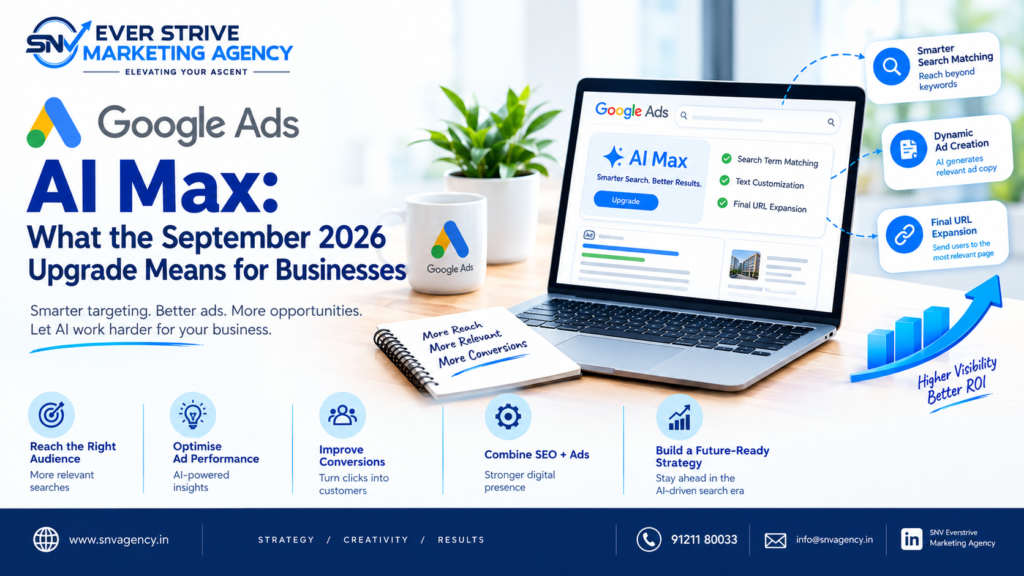
Google Ads is moving further toward AI-powered Search advertising, and September 2026 marks an important stage in that transition. AI Max for Search campaigns is becoming a larger part of how Google helps advertisers match ads with changing search behaviour, create relevant ad assets and discover additional opportunities.
For businesses investing in Google Ads, this means campaign management is becoming less dependent on traditional keyword-based setups and more focused on signals, intent, creative assets, landing pages and conversion data.
What Is Google Ads AI Max?
AI Max is not a completely new Google Ads campaign type. It is an optimization layer within existing Search campaigns that uses Google’s AI capabilities to expand how campaigns identify relevant searches and optimize ad experiences.
According to Google’s official documentation, AI Max includes capabilities such as search term matching, text customization and Final URL expansion. These features can help Google understand the context of a user’s search and connect that search with relevant advertising content and landing pages.
For businesses, the important change is that advertisers can provide Google with more signals and controls while AI helps identify opportunities beyond a traditional keyword-only approach.
What Is Changing in September 2026?
Google originally announced that Dynamic Search Ads (DSA), Automatically Created Assets (ACA) and campaign-level broad match settings would move toward AI Max during September 2026.
However, Google later extended the timeline for the automatic DSA sunset and upgrade to February 2027. At the same time, Google confirmed that eligible campaigns using Automatically Created Assets and campaign-level broad match settings would continue to be automatically upgraded beginning in September 2026.
This distinction is important for advertisers because not every existing Search campaign is facing exactly the same change at the same time.
Google’s current AI Max documentation also explains how existing DSA campaigns can be upgraded, including the transition from dynamic ad groups to standard ad groups and the use of responsive search ads and AI Max features.
How Does AI Max Work?
AI Max brings several AI-powered capabilities together within Search campaigns.
1. Search Term Matching
AI Max can help advertisers reach relevant searches that may not have been included in a traditional keyword list. Instead of relying only on exact keyword planning, Google’s systems can use additional signals to understand the intent and context behind searches.
This can be particularly useful when customers use different phrases to describe the same product or service.
2. Text Customization
AI Max can generate customized ad assets based on information such as the advertiser’s website, landing pages, existing ads and keywords.
Advertisers can also use text guidelines to provide messaging restrictions and brand-related instructions. This gives businesses more ways to guide AI-generated advertising content while maintaining consistency.
3. Final URL Expansion
Another important feature is Final URL expansion. Instead of always sending users to one predetermined landing page, Google can identify a more relevant page on the advertiser’s website based on the search query and ad context.
For this reason, having a well-structured website with clear service pages can become increasingly important for businesses using AI-powered Search campaigns.
What Does This Mean for Businesses?
The move toward AI Max changes the role of campaign management.
Previously, advertisers often spent significant time building keyword lists, writing multiple variations of ad copy and manually controlling targeting. AI Max does not remove the need for strategy, but it changes where that strategy is applied.
Businesses should focus on:
Clear and useful website content
Strong landing pages
Accurate conversion tracking
Relevant advertising messages
Clearly defined brand guidelines
Appropriate location and brand controls
High-quality first-party data
Regular campaign testing and analysis
Google is also introducing new AI Max testing and planning capabilities. In August 2026, Google announced tools for testing budgets and ROI targets across multiple Search campaigns, along with additional controls for brand and location settings.
Why Website Quality Matters More
AI-powered advertising still needs quality information to work with.
If a business website has unclear service descriptions, weak landing pages or poorly structured content, AI systems have less useful information to understand what the business offers and which page may be relevant to a particular search.
This is where SEO and paid advertising can complement each other.
SEO helps businesses build useful, search-friendly website content, while Google Ads can help businesses reach potential customers through paid placements. Combining both approaches can provide businesses with multiple ways to reach audiences throughout the search journey.
What Should Advertisers Do Now?
Businesses don’t necessarily need to completely rebuild their Google Ads accounts because of AI Max. Instead, September 2026 is a useful time to review existing Search campaigns and understand which AI Max features are active or applicable.
Advertisers should review campaign settings, conversion tracking, landing pages, search terms, ad messaging and performance data before making significant changes.
Google also recommends using experiments to test AI Max and understand its impact rather than making decisions without performance data.
For businesses that are already investing in Google Ads, this is an opportunity to make sure their website, tracking and advertising strategy are ready for an increasingly AI-driven search environment.
The Future of Google Ads Is Becoming More AI-Driven
AI Max represents a broader change in digital advertising: search campaigns are moving from purely manual keyword management toward systems that can interpret intent, content and multiple signals.
For businesses, the fundamentals still matter — a clear offer, strong website, relevant content, accurate tracking and a well-defined marketing strategy. AI can help scale these inputs, but it does not replace the need for a strong foundation.
As Google continues developing AI-powered advertising, businesses that regularly test, measure and improve their campaigns can adapt more effectively to changes in how people search and discover products and services.
Looking to improve your business’s online visibility and paid advertising strategy? Explore how SNV Ever Strive Marketing Agency can help your business build a stronger digital marketing strategy across SEO, performance marketing, social media and website development.
Ready to Adapt Your Google Ads Strategy?
At SNV Ever Strive Marketing Agency, we help businesses adapt to the changing digital advertising landscape with a practical, performance-focused approach. From Google Ads campaign setup and optimization to SEO, landing page development, conversion tracking and social media marketing, our team focuses on building strategies around your business goals and target audience. As Google Ads becomes increasingly AI-driven, we help businesses make the most of automation while maintaining the right messaging, website experience and conversion strategy. Whether you are starting your first paid search campaign or looking to improve an existing one, SNV Ever Strive can help you build, manage and continuously optimize a digital marketing strategy designed for sustainable growth.